Episode Transcript
[00:00:06] Speaker A: Hello. Welcome to Small Town Girl.
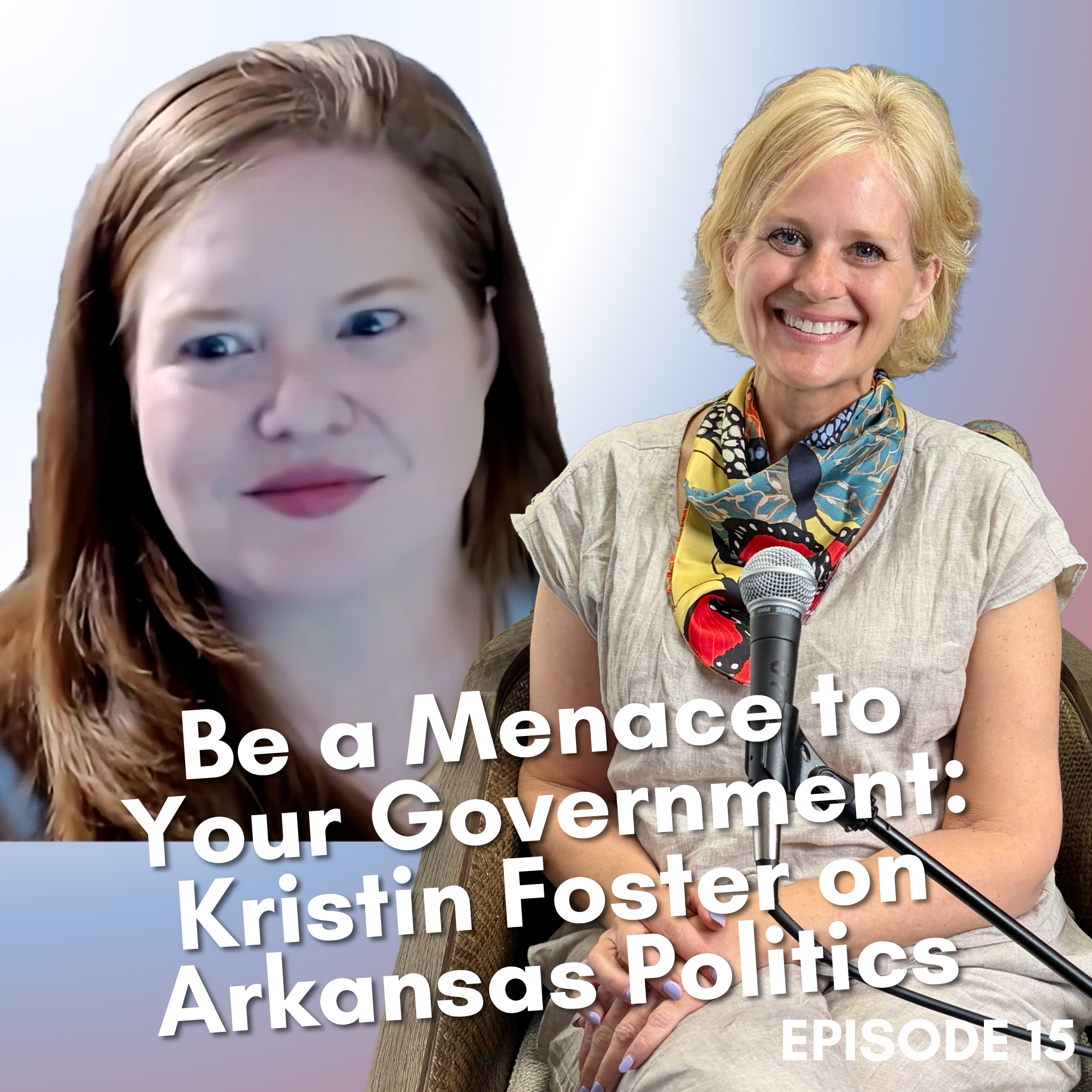
We have a very special guest today named Kristen Foster. Readers may remember that I wrote a column about her, seeking to honor her for her work to help get more voters registered in Arkansas in and her big brain behind the project and the website that makes that possible when she was working with Get Loud Arkansas.
And I'm gonna have Kristin tell you guys a little bit about herself because she's kind of, she's done some different things since then and she's in this space now of influencing.
I think it's content creating is the correct way to say that probably.
Kristen and I interviewed another friend of mine who's from Arkansas, but he lives in New York City now. He's a former teacher and he is, he's on, he's an influencer on Book Talk. But he told me that people in the space don't call it influencer. And so I didn't know that. But anyway, I'm so pleased to be able to have this hour with Kristin. She's on a pretty tight schedule and so I'm going to try to get myself on one because she has a lot to share with us today. So I want to get right into it.
Southern Loft believes that your home should reflect your unique personality. That's why they offer a wide variety of stylish furniture pieces that are perfect for any taste.
Whether you're looking for a new sofa for your living room or a sleek dining table for your kitchen, they have just what you need.
So when looking for that piece of furniture that reflects you, visit Southern Loft at 3155 North College in Fayetteville or call at 479-856-6100.
Kristen, you are a. Well, you can describe what you do in the more professional terms. I would call you my, one of my go to people when I need to know what is going on. When I'm, you know, I'm always looking for content creators I trust to tell me, you know, what's happening in one area or another.
And when I, you know, when I need to know, say what's going on in a session, special session or a fiscal session like we just had in Arkansas. And I used to keep up with that a lot more closely myself. I, you know, was doing some, some nonprofit advocacy work and that's where I met you when you were working with Getloud. And, you know, I would hang out at the Capitol and really kind of keep track especially during the time of, of the, the passage of learns and, but I've kind of gone in a little bit direction, I'm still a different direction. I'm still very interested.
And I do, you know, hone in sometimes to get a, you know, a pulse. And I guess that's kind of what I want to do today. But I also.
So I want to do that today with you. I want you to break it down for us.
And then. And what I'm also hoping to do with this, this vodcast is to introduce you and your platform to Arkansans because you really perform a great public service for, for us in keeping a close watch on what's happening and then breaking it down into, you know, small bites that anyone can understand.
And, you know, I might say just from the beginning that, you know, I'm an opinion columnist. Kristen, is, like I said, you're not exactly a journalist, not exactly, you know, an influencer. You definitely have, you know, strong political leanings and strong opinions about what happening. It might not be the same as all listeners will feel, but what I love is that you're very upfront about that and the information that you present is very thoroughly researched. It's going to be factual, you know, fact based. And then if a reader or someone listening wants to draw a different conclusion than you have, they can because they're going to get the facts and then they're also going to get your often very funny commentary on it.
So without further ado, Kristen, tell us a little bit about your background, how you got interested and how you got to this, you know, inhabit this space that you are right now. You're in West Memphis, right?
[00:04:56] Speaker B: Yeah.
[00:04:57] Speaker A: Working. Okay, so take it away.
[00:04:59] Speaker B: Thank you. No, thank you so much. That was the most kind and gracious intro ever, I think. But I appreciate your work so much and I appreciate the column you wrote talking about some of the work I did with Getloud Arkansas. I've been very honored in this kind of movement work to have incredible mentors. I worked under Senator Joyce Elliott, like you said, when she was with Get Loud Arkansas. Before that, I worked in ballot initiative work. I've worked in civic engagement and just advocacy work for about the last 15 years.
I do live in West Memphis now. I am the executive director for the League of Women Voters of Arkansas.
Still trying to get more people involved in government here. But when you talk about, like, my content creation, if people ask me, you know, what I do, I like to say that I try to teach people to be a menace to their government.
Okay. Yeah, I think we need more of that. Like, and I don't mean that in a, you know, in the way I think a lot of people sometimes think of it, I don't mean that to go and be mean or to be disrespectful or to, you know, do things that are counterproductive. But I mean it to be, like, be so informed, be paying so much attention that they can't pull one over on you that, you know, know what's going on. And so the spin that often happens in politics isn't going to be effective on you if you know more of the facts about what's going on. And like you said, I do share my opinions pretty openly, but I try to be clear when it's my opinion versus the facts of the issue that's going on. And so I'm excited to talk about fiscal session with you, share some breakdown on, on where people's tax money is going and how it's being spent. And especially with this special session that followed right after fiscal, where we had another tax cut added, there's been a lot happening in Arkansas politics. And, you know, I got my start in Arkansas politics. I had started a child hunger agency in Russellville when I think it was around 2012, because our weekend backpack program was ending and Arkansas was the worst state in the nation for child hunger at that time. We, we got better for a while.
We're back to being one of the worst. But in that work, I realized that feeding kids is wonderful, and when kids need food to take home on the weekend, we should absolutely be making sure that happens. But ultimately, it is a band aid. It's not changing the root causes or the systems that create poverty, really.
And so I got really interested in how we can do better for people in this state, how we can make public policy that serves regular people. I grew up in poverty. I'm not the kind of person that would typically have a seat at the table. And so I take that very seriously because I think it's a privilege to be there and be a voice for people who have lived the struggle. Right. Like, not everybody who's at the table has ever experienced that. And good for them. Like, it's not like, you know, they should have experienced that, but we need to have all voices at the table. And so being able to be one of those voices is a real privilege.
[00:08:03] Speaker A: Well, I appreciate that so much, and I feel like it does give you a certain authority, you know, to speak to that.
And I also believe, and I get this kind of feedback, you know, from my columns, that there are a lot of people who want to Be better informed. It's just so much information to sort through.
And, and with all the misinformation that's there, it's hard for a lot of people to know, like, where to get their information and whether it's true.
And the truth is we are all biased. It's not a mean thing. It's just like kind of because we all have a life story that we come from. And so I think just kind of owning our biases and saying, here's who I am and why.
But trying to, you know, build bridges by just sharing information so that people can be aware is really important work.
And so let's dig in. You know, I know we did just have a fiscal session.
And so that is the session where the Arkansas legislature decides the budget. Right. Decides like where to spend money.
And so tell us a little bit about like what was on the table and how, you know, how we decided or how our elected officials decided to spend our tax dollars.
[00:09:38] Speaker B: For sure. So the fiscal session. So for people who are unfamiliar, Arkansas has a legislative session in odd numbered years. And then we have a fiscal session where they only focus on the budget in even numbered years. And it's really just making adjustments. They pass a two year budget during the legislative session, but they come back and make adjustments based on actual revenue and based on feedback from state agencies and department heads and from the administrative, I'm sorry, from the executive branch, telling, you know, what they need, what's coming up, just giving real time feedback so that they can make adjustments.
Because Arkansas is required to always run a balanced budget. We never run a deficit. Doesn't happen in Arkansas. We run a balanced budget. And so this is part of that is just making those adjustments.
What we saw this year going in was we knew that the state's new Educational Freedom Account program, the voucher program, that, that was going to be a top ticket item for Governor Sanders when it comes to what our funding gets adjusted to because they've had a lot of students enroll in that program and the cost has gotten very large. The other thing that has been a change just over the last few years is a major increase in spending on corrections. And so those were kind of some of the big things. Otherwise there were not a lot of major changes to the budget. There were a few shifts here and there, some universities gained and lost funding, you know, things like that that were happening, but really not a lot of just major, major changes to the budget. But I do have a couple of slides I'd love to show you, especially when we talk about spin or misinformation. I guess you can, depending on how you view it, could be either way. So I'm going to pull up these slides to show you. For folks who are just listening, I can share more information as well. But what you see here, this was, this is a resource put out by the state, this dollar that shows the breakdown of if, you know, if you pay a dollar of taxes, this is what it goes to. This was going into session. This was provided. They haven't provided an updated one with the changes as they are. So this was kind of based on the last budget.
And this looks really good, right? It looks like we're spending a lot of money on education, a lot of money on support programs through the Department of Human Services and Health Department, then higher education, then you have this correction department and community Correction department, and then 7% as general government and local aid.
But if you look at how this has changed over the last 10 years, okay, I think this gives you a more realistic look of where our money's going and how our government's priorities have changed in the last decade.
So in 2015, our overall budget spending was $5 billion. Ten years later, 11 years later, we've increased that to $6.5 billion. So we are spending more, but how we're spending it has changed. If you can see on the slide, 10 years ago or 2015, we were spending 42% on public schools.
Now, we've increased that spending a little bit, but it's actually only 39% of our full state budget. So overall spending has decreased. But the thing that I think is really important here that's easy to miss in all of this is in 2015, our general government cost included corrections, okay? It was not a separate category.
Now, in 2026, corrections is 9% of the budget. It's its own separate category. And General Government is 223. So now in 2026, we are spending more on corrections than we were spending on the entirety of general government, including corrections in 2015.
[00:13:43] Speaker A: Oh, wow.
Yeah.
So where's that going? What's that mean?
[00:13:50] Speaker B: Well, let me take this slide down so we can just go back to chit chatting. Well, you know, our state has increased our rate of incarceration for people. I saw a statistic a couple of years ago and I'd have to go back and find the source for you, but it said that that if every state in America was its own country, every state was its own country, then globally, Arkansas would rank 11th in the world for incarceration per capita.
11th in the world based on incarceration, per the number of people in our state, percentage wise. Right.
We have an incarceration crisis here in the state. And the response to it has been to spend more and more and more on it. Not so much on preventative programs or addressing the underlying causes that we know cause people to be more likely to be involved in crime, but instead just on addressing the crime itself after it's happened by locking people up for longer and longer and longer. And that's just continuing to grow. It's one of the main projects that Sarah Huckabee Sanders has been focused on since she came into office was building a 3,000 bed mega prison. This is a trend that's happening across the South. It's not isolated to Arkansas, but it is a huge, huge expense and it is something that is going to continue to keep growing for our state.
[00:15:21] Speaker A: Okay, so what is the, what's the rationale? Why is this a trend across the South? What are people saying who, you know, who want this, to spend this money this way, who think this is needed?
What is the, what's the reasoning?
[00:15:44] Speaker B: So I think the argument is generally that of course everyone wants safe communities. Right. That mean.
And that's completely fair. Everybody wants to live in a safe community and people should have safe homes to live in. Right.
But I think a lot of the argument comes down to how do we address people who are at risk and people who maybe have been involved in the justice system but now are out to prevent recidivism, to prevent them from going back in.
And, you know, on the left Democrat side, which was kind of still in control more or there was not a super majority of Republicans back in 2015. So there was, I think, more focus on some preventative measures, community correction, probation and parole and things to lower recidivism. Where I think the more conservative approach to that has been to have harder sentencing and to kind of crack down more.
And both of those things have good and bad. Right. Like neither one of those is a solution in its own right. In my mind, there's a balance between the two things that have to happen and we haven't found a way to strike that balance, basically.
[00:16:59] Speaker A: So are things, have things gotten better with this increased spending in the sense of has crime been reduced?
[00:17:11] Speaker B: No, I'm not an expert for sure, like on, you know, crime or anything like that, but my understanding is it hasn't really been significant. We have continued to have increases in incarceration rates, of course, and not really seen reductions in the crimes themselves. That lead to the incarceration.
[00:17:31] Speaker A: Okay.
[00:17:33] Speaker B: And there's a lot of research and a lot of schools of thought on how you approach that. And there's no perfect answer. Right. Like, I want to be clear, something that I think a lot of people miss about public policy, and we end up, like, dehumanizing the other side and, and treating the other side like they're evil and wrong. Is there, There is no policy that is going. Excuse me. There's no policy that is going to be perfect for everyone. There are always winners and losers in every single public policy. There's good and bad tied to everything that you try to do. And so, you know, for me, the goal of public policy should be, I believe it should be to do the most good for people with the least amount of harm.
[00:18:11] Speaker A: Yes, I agree.
[00:18:12] Speaker B: And I think most people agree on that. Right.
And so even if people are trying to reach those same goals, how we get there is just hard.
[00:18:21] Speaker A: Yes.
[00:18:21] Speaker B: Because there is no perfect answer. It's not like, well, if we only build these prisons and then we do these programs, everything will be fine. Right. It's always going to be an evolving issue that, that it's a struggle.
[00:18:32] Speaker A: It's never going to all be fun.
[00:18:33] Speaker B: Right.
[00:18:34] Speaker A: It's, it's never going to all be fun. But we, we, we wrestle with what does the most good for the greatest amount of people and the least harm.
And so the reasoning here is that a lot of, you know, I guess conservative legislatures and governors in the south believe that this, to incarcerate more people, to have harsher punishments will, will make us safer, make our community safer. And, and that that justifies the, the cost.
Right.
[00:19:19] Speaker B: I think, you know, if you have harsher punishments, people are less likely, will be less likely because they don't want to experience.
[00:19:25] Speaker A: Right, right.
[00:19:26] Speaker B: And there's, you know, there is some logic behind the. We do have an issue in our state where, like, people get released early often.
Now, I'm not necessarily personally a big fan of these, like, serve 100%. I think you need to incentivize people to grow and, and make progress and become a better version of themselves while they're incarcerated. Like, I don't think, and I think you lose that a little bit with these, like, 100% sentence rates, but that's what we've gone to because there's this concern that, like, when you do release someone early, are they just going to go out and, and commit another crime? And are people going to be harmed by that who are innocent? And, and the answer is Sometimes, yes. And so, you know, it is hard.
[00:20:08] Speaker A: Okay, so where are we going with all that?
[00:20:17] Speaker B: Right now we're going towards a 3,000 bed prison, but we don't know what location it's going to be in because they agreed to not put it in Franklin county, but they haven't disclosed any location yet. So I think we're going to find out. And hopefully, hopefully this time they will learn a lesson and will be more inclusive of the people in the communities that are impacted when they do identify a location. Have more public input and transparency in the process.
[00:20:45] Speaker A: She said she still thinks Franklin County's the best. The last I heard from her was that she still thinks Franklin county is the best place.
So.
[00:20:56] Speaker B: Yeah, yeah, yeah. And then the other area where we see the biggest increase in spending in this particular session is, of course, the Educational Freedom accounts, the vouchers. And it's a very similar situation about, you know, you have folks on the right who argue that parents should be empowered with those dollars to choose the school that's right for their kids, whether that's homeschool, private school or public school.
And I can understand that logic. Right. As a parent, you know, you want what's best for your kids. Like, I can understand why people want to take advantage of that opportunity, especially if they feel like their kids are not getting what they need through the public school system.
But then on the left, you have folks who are saying we should be investing that money into our public school system. And if we were doing that, all, you know, all boats rise, right? Like that. We bring everybody up by doing that. And so again, it's just kind of this, how do you approach a really difficult situation that's never going to be right for everyone?
[00:22:05] Speaker A: So. So talk to us about those dollars and those dollar amounts and what that means.
[00:22:12] Speaker B: All right. So the biggest amount of spending this session was adding money to the EFA accounts. I think it was 180 million that was added to that.
And it's one thing where I do have deep concerns about the spending because we are pulling money out of our reserve funds. And I think that, you know, everybody knows, right, if you're trying to pay your bills every month, but you're having to take money out of your savings to meet those commitments, you don't have a balanced budget.
[00:22:47] Speaker A: Right, right.
[00:22:49] Speaker B: And so that's the situation we are in. We are spending more money every year on these and we're having to pull it out of reserves because our revenue is not keeping up with the cost.
[00:22:59] Speaker A: Right.
[00:23:00] Speaker B: And so that means we don't do new spending and new investment in programs that need to be expanded.
[00:23:07] Speaker A: Right.
[00:23:08] Speaker B: And they just all kind of sit stagnant. We know things aren't getting any cheaper, right? Like it's not getting any cheaper to run these programs. And so programs like SNAP and, you know, child advocacy centers were one that I've been very concerned about seeing cuts to because they're having to scramble and make up for these, for not receiving more money. So I think that that's, I mean, that's always what fiscal session is, is. It's, how do we prioritize the resources we have?
[00:23:40] Speaker A: Well, you know, I have, you know, looked at this one pretty closely and what concerns, well, one of my great concerns about it is that we can see how this has played out in states that are already a little bit ahead of us. You know, Arizona, for example.
And you know, my, my fellow columnist Rex Nelson keeps on saying, you know, we're about to go off a fiscal cliff.
And you know, he's, he's not a liberal guy and he's also been around a long time. You know, he's, he's watched this wax and wane.
And so, you know, I think for him to say that repeatedly and sort of be like, you know, the house is on fire, the house is on
[00:24:40] Speaker B: fire,
[00:24:43] Speaker A: we need to listen.
And it's not hard to see why he's saying that when you just look at other states. That was really kind of what I was getting at with the, you know, the corrections money, which we can definitely go back to, you know, but I don't know as much about prison policy as I do education policy. I know that it makes me sad to hear, you know, that we are 11th in the world.
If we are the country, you know, that Arkansas itself, which is, it would be a tiny country, would be 11th in the world in incarceration. I just can't believe that our people are that much meaner, you know, worse, evil, criminal minded people that they need locked up, you know, more than, you know, at number 11.
That's a lot of countries that are doing something better than we are, it seems to me. And so I'm interested in knowing, you know, what their crime rates are and if they're lower, what they're doing.
You know, that is working. To me, that seems like that would be the logical thing to do there. So we could go back and you probably know some of that where I don't, I mean, I do have some experience in some other countries that feel safe, you know, that are doing Some different things. But as far as policy, I am not schooled in that.
But when I look at education policy and then I watch these other states that are implementing this, you know, one of the things I see is there's absolutely no evidence that outcomes are improved by the Education Freedom accounts, so called, you know, they're vouchers.
An Education Freedom account sounds a lot better than a voucher, but that's what they are.
And there's no evidence that supports the idea that outcomes for students are better.
And so that's troubling because why would we do it?
There's another reason why we do it other than better outcomes for students if there's no evidence that it improves outcomes.
And then the other thing though is states that are literally going off a fiscal cliff, you know, like Mr. Nelson has warned repeatedly.
So talk to us about like down the road, these numbers that we're, you know, saying that, you know, we're committing to these numbers. I heard, you know, Bart Hester say something like, he would never put a cap on it.
Where's he going to find that money?
You know, people like me know, you know, look at that and say, well, you have to find it somewhere and you have to cut somewhere else. And, and obviously that is likely to be the public schools budget.
So talk about that. What these numbers, you know, we hear these giant numbers and it sounds appalling, but it's so big, it's almost like, well, what does that actually look like? Like when Rex Nelson says we're heading off a cliff, like, how close are we to the cliff? How many years does it take for us to, to fall down and crash and burn and then what do we do about it?
[00:28:35] Speaker B: Yeah, well, when it comes to fiscal cliff, you know, I think that what's likely to happen is, you know, if nothing changes and the economy doesn't tank at any point, we may be okay. We're going to have to keep our belts tight, but we may be okay for a little while.
It's as this spending continues to increase and then if we have a bad year, like we don't hold a lot in reserve. We have a catastrophic reserve, but we don't hold a lot in just like the rainy day fund. Right.
[00:29:06] Speaker A: And we're spending that. Right. We're spending our reserve.
[00:29:08] Speaker B: Spending that down. Yeah, exactly. Spending that down. And with giving this tax cut, we cut what we would expect to get in over, you know, over what we need for the budget. Right. In revenue, over what we have to have to pay out the budget. We expected to get about $360 million that would go into reserve.
Well, with the tax cut, we're only going to have about $180 million that are likely to go into reserve at the end of this fiscal year. Now of course you don't want government collecting way more money than they need, right? Like they should be collecting money and then investing it back into the state to serve the people.
But it is this question of what you said about the priorities around the voucher program and not putting a cap on that because it is, it is. I think we're going to see the fiscal start to happen at the local level first. And we already are starting to see that there's been a major reduction in the amount of funding that goes back into counties from the state.
So states receive, or I'm sorry, counties receive turn back funds. They call them turn back funds. But it's really not turn, it's not turn back, it's people hear that and they think it's like oh, money that was paid in like county sales tax that then they're getting turned back. That is not what it is. Turn back funds is an amount that is set aside by the state to fund programs that are state mandated programs but that are provided, administered on the day to day basis by local government.
So county jails, police, things like that, fire, things that are mandated by state law that the state requires them to do that the state should be paying a class for. There was a time when we started turn back funds that it covered the entire cost of the state's portion for these things, but we have not increased investment into those turn back funds. So county government is getting way less than it was a few years ago, but they still have to carry out all of those things.
And so what we end up seeing is our sales tax increases, local tax rates increase and those costs are often paid by the people with the less, the least amount of income. Right. As a, as a proportion of their money they have to live on.
So if you look at our current sales and excise tax system in Arkansas, the lower, the lowest 20% of earners, people with the least amount of money, about 10% of their income keep biting my tongue. About 10% of their income goes to sales tax and excise tax. Right. 10% of their overall income. But when you look at the top 1%, only about 1.5% of their income pays into sales tax. Right. And so when you talk about like this disproportionate benefit to the top and to corporations that we see a lot of times we'll see an argument against that because they say, like, oh, well, no, the top income tax rate is this huge group of people. Right. Like our income tax rate breaks at like, I can't remember the number off the top of my head, but it's like a very, like 50,000 a year or something. It's not like a high level. And then everybody above that has the same rate. But where we make up that lack of funding is in our sales tax and our excise taxes, and they end up disproportionately being paid by people with the least amount of money to spend.
[00:32:39] Speaker A: So you're talking about, like, when you go into the flower shop and you buy some flowers and then you pay a 10% tax on top of that. That's where we make it up, is what you're saying. And so that's what local people are, you know, doing.
Or. Yeah, or like, if you're in a small town, you may go get your groceries or you, you may do. And I know the grocery tax. We can talk about that in a minute.
So let's, let's, let's say it's not groceries. Let's say you're going to Walmart and you're getting your dog food and you're getting your, you know, your toothpaste and your paper towels and things like that, you know, and a lot of people will travel out of their small town, like to Fort Smith for us or Fayetteville or whatever, and do that. And so then you're paying their tax. It's not even going to your community, but it's, that's, that's where you're saying that this tax amount is, is getting made up.
[00:33:41] Speaker B: Yeah, it's often made up there in that, that sales tax. And like you said, a lot of
[00:33:46] Speaker A: various vehicles, things like that.
[00:33:48] Speaker B: Yeah, yes. And property taxes as well. You know, when it comes to your schools, this, this lower funding to public schools, we're going to start seeing pushes to increase millage rates and pay that out of property tax. It's not like those expenses just go away. Yes, schools may have to tighten their belt on some things, but there is still an expense. And, you know, schools have buildings and all of these things to upkeep that a lot of homeschool and private school parents don't have that same level of overhead to deal with.
[00:34:20] Speaker A: Well, that's the thing that is always so maddening to me when people say, and I think a lot of people who say this, you know, just the average citizen, they don't know, they don't think about it, but politicians know, or they should know this.
You know, when people say, and you know, if I had a nickel for every time I've seen this in a comment on Facebook or something, I'd be rich. But it, it was, they, they say things like, the money should follow the student, and if I take my student to, you know, homeschool or private school, that money should just follow them. You know, you're.
The public school may be losing that money, but they're also losing that student.
It's so frustrating to me for politicians to use that as an explanation and act like it's just simple because it's exactly what you just said.
If a student is gone from a classroom, that classroom still has to be provided for the other students. It still has to be heated and cooled.
You know, the teacher still has to be paid, the custodian who cleans it still has to be paid. The supplies still have to be bought. You know, the technology still has to be there and the bus route still has to run.
And, you know, it's just what's happening, you know, and I should have looked this number up. I didn't really think about needing it. But I heard something the other day about how many students one of the schools, maybe it was Springdale, had lost to homeschool and private school.
And it was this huge amount of funding.
And when that happens, you know, you eventually close buildings, you know, you eventually cut staff.
And it's not proportional to what the needs are. I mean, obviously you don't need as many buildings or you don't need as much staff as someone might, as you do if you got a whole bunch of students. But in this time that you're trying to even out, I don't know, it's just, it is.
It's so frustrating because I think what's going to happen is we're going to shutter some schools and some buildings. We're going to lose, you know, professional educators. We are losing professional educators.
And you don't instantly get those back, you know, and your community, you know, like for us in Ozark, I think the school is the number one employer. It is in most small towns.
And things. It. You talk about trickle down. Things start to trickle down when you, you don't, you know, you don't have those jobs. And anyway, so, so it's a, it's a concern and it's a bogus explanation or argument that, you know, that that is, I think, disingenuous for people to say in order to support, you know, this policy that they want to put forward in order to please, you know, the people who are really benefiting, who are their wealthy donors. And I know there are some people caught in the middle of all that, but we know that that is the primarily who benefits, and certainly not, you know, the student who, you know, needs the extra services that the public school is too crunched to be able, you know, to provide or to provide, you know, to the degree that it's needed.
[00:38:32] Speaker B: Right. And people don't think about just all of the things, I think, that get layered on. You know, I remember one session they had added dyslexia screening for every student. Fantastic.
[00:38:43] Speaker A: Yes.
[00:38:44] Speaker B: Great. Wonderful. Somebody has to do it. There's a cost. Right. And there's no line item added that says, here's your extra $25 per student to cover the cost of dyslexia screening or whatever. And I'm sure it's probably more than that.
[00:38:58] Speaker A: Yes, just do it.
[00:39:00] Speaker B: That's not how it works. There are things that are constantly added on without any new additional funding tied to them. And that's not just in education. It's across our state government.
They talk about this fiscal cliff. Like, these are the things we're running up against, because this is happening to local government. It's happening to just all of our systems right now, honestly, where we're not adding new money in, but we're telling them to do more with less. Right. So.
[00:39:29] Speaker A: Yes. And it's actually like, it's.
It's a law. It's a requirement that you, for instance, provide, you know, dyslexia screening, which. Great. I love. I want everyone to be screened. But, you know, you're gonna break the law if you're not doing it, but you don't have the money to do it, because the people who made the law aren't, you know, backing it up with the funding to do it.
[00:39:54] Speaker B: Right.
In the same way.
[00:39:56] Speaker A: Yeah. I was gonna say, describe some other instances where this stuff happens, because for me, you know, I know. I know the education wants. But that's, you know, that's a bubble for me. What are some of the other places you're seeing these things happen?
[00:40:09] Speaker B: So the child advocacy centers are a great example of this. Now, if you don't. If people don't know what a child advocacy center is, consider yourself lucky, honestly, because they serve a crucial need for children who have experienced some of the most horrific things that can happen to a child.
[00:40:28] Speaker A: And.
[00:40:29] Speaker B: And they have experts who can provide real support for, you know, gathering Evidence for criminal proceedings, for taking in physical evidence. You know, I mean, and they, they do these things in a way that is not creating just more harm as much as possible, right? They're trained for this. Well, there's been funding from the Department of Health and Human Services that went to these centers across the state to support their, their work doing this. And I had a lawmaker come up to me because then there was, you know, started to come out and he said, but they don't have the money anymore to continue these grants from the Department of Health and Human Services to these child advocacy centers. And I had a lawmaker come up to me and he was like, why is this happening? I don't understand, like, we should have this money. And I was like, buddy, y' all just came through and told them that they had to raise everyone's pay, right? And we all know if you've ever run a business, one of the biggest expenses is your staff, right? Like, it costs a lot of money to employ people. So when you give everybody a raise and it's not because they didn't deserve a raise, I'm not against the raises. These are folks who work very hard and are not paid enough, you know, and it was raises to law enforcement, to corrections officers, to social workers, to people who really deserve to be paid for.
But there was no new funding, there's no new money. And so how do you pay for it?
You, you would never, as a business owner, give everyone a pay raise if you knew it was going to cut into your ability to do your day to day business and stay successful and afloat. Right.
[00:42:10] Speaker A: You know, the way that that happened in education is now we were going to pay, you know, all beginning teachers 50,000, which frankly is, I mean, that's great. I think they should be paid more. And I think, I mean, we're talking about the people your kids spend eight hours a day with.
And it's the number one, you know, factor in how well a child succeeds in school is the teacher. That's the number one factor.
It's not all the other stuff.
And so to me, we should be investing a lot in these people who do this work.
But so 50,000, like, raises it completely out of the, you know, the doldrums of poverty to a, you know, a level that's not just completely embarrassing, but I mean, I would argue for it to be higher.
But, you know, and, you know, supposedly that is funded.
But then what do you do with your teachers in these districts who have worked there 20 years and they're not making $50,000 yet.
And how do you make it, you know, at all, you know, reasonable?
And then how do you raise it from where those beginning teachers aren't making $50,000 in 20 years. You know, are you going to. Do you think you're going to keep a teacher who doesn't, you know, have a step and get right? You know, it's just like if you're making $50,000 now and you're making $50,000 in 10 years, it's not going to go the same distance. You know, you're gonna have a growing family, you're gonna have all these. And so the exact same that happens. You know, we just talked about it with dyslexia, but it happens all the time in education. You know, here's this great idea that we're gonna have schools do, which, okay, you know, let's do it.
[00:44:04] Speaker B: But.
[00:44:04] Speaker A: But if you don't fund it, then something has to give.
And that. That is just insane. I didn't know that, that that had happened, I mean, because I would have, you know, you hear that, and you would be cheering that people are getting a raise because, you know, they need it.
But then.
Then we. We can't do the work that our kids need, you know, in our families.
[00:44:32] Speaker B: Yeah. People who are. Who are watching closely are going, hey, where do you make up the money? Because we don't. We, like I said, we don't run a lot of excess revenue in. Right. So what we heard from the Department of Health and Human Services when they came back to Joint Budget, and they're going, hey, why don't you have this money? They're like, listen, we got cuts from federal funding.
We got told to spend down our reserves for state funding, and we had to. We had to make up costs in places. Because it's not just that. Just the general cost of everything, of paper, of ink, of pencils, of computers, everything has gone up. Right. And so when you're not increasing their revenue to do that work, you're not increasing the investment to do that work.
Logic tells you cuts are going to have to be made, but those are getting made by people doing the work every day, and they're often not visible.
[00:45:25] Speaker A: Yeah.
[00:45:26] Speaker B: You know, until. Until there's a crisis where something happens.
[00:45:30] Speaker A: And. And that's where I see this. The cliff. You know, how close is it?
Because unless you're just inside the school or, you know, inside maybe these. Duchess. Or you're these, you know, children and families who need this desperately, you know, on the outside, it may not affect you. You may not see it happening, but then we're going to feel like the ramifications. You know, there's lots of people, I think, in the town of Ozark who don't necessarily realize that, you know, if a teacher retires, he or she may or may not be replaced because we got to tighten the belt there. We may have a specialist in.
In math, you know, who also takes on the reading specialist job, so takes on a whole other job, but it just absorbs it instead of getting. Instead of having two people doing that job, which we had before, and then they're spread, you know, double thin.
But you don't necessarily see that or feel that the effects are, like, you know, down the road. And it's the same thing with, you know, you know, schools, like, trying to make do and trying to make do, and then something's gonna get closed down, you know, and then who's there to clean up the mess? And what do you have to do to get it functional?
It's heartbreaking to me to imagine, and I'm sure it has to be so heartbreaking to people who have worked so hard, you know, before us, to. To put these things in place. I think of the. Those who, you know, who. Who brought the Lakeview cases and who.
You know, who. I think of the Little Rock Nine. I think of people who, like, have worked so hard to get us, you know, the wonderful, you know, governors and legislators we've had, who have. From both parties, who have, you know, worked so hard to bring us, you know, to a better spot and then to see some of it just dismantled is so heartbreaking, you know, to me, trying to imagine, you know, taking it.
Taking it for granted and then just seeing it sort of. Sort of slip away. And I think, you know, you alluded to that when you were talking about hunger.
Talk to me, just. We've got just a few more minutes, and then I know you have another meeting or a place to be.
Talk to me just a little bit, Kristin, about, you know, fixing.
You know, I think there's a disconnect. People here cutting taxes. That sounds good, right? Like, I had to scrape together money to pay my property taxes, you know, when they came due, and I don't have very much property.
[00:48:43] Speaker B: You know, I love to pay less taxes. Nobody wants to pay more taxes.
[00:48:47] Speaker A: And, you know, to not pay taxes on groceries. That sounds great, but it's a balancing act. And this is why I'm always advocating, I think, for like, balanced, you know, perspectives in governments on the. On the left. And. Right. Instead of a super majority either way. Because you have to have a balance in this perspective. Yes, maybe it's great to not pay taxes, but then you lose these things and it ends up costing your, you, your state, you know, more.
Plus you're, you're living in a place where that's, you know, one of the hungriest states, you know, in the nation. Or talk to me about where you see some of that going with these, these tax cuts.
[00:49:40] Speaker B: Yeah.
[00:49:41] Speaker A: Where are we headed if we keep this mentality, if we keep this super majority, what are the systems? What are the breakdowns?
[00:49:54] Speaker B: Well, let me talk about the mentality for just a second first because this is something I meant to go into earlier when you mentioned Bart Hester. I heard him say something and it really stuck with me and I've heard it said in the legislature by many other lawmakers as well. But I think it's a mentality issue of he was talking about with the voucher programs that, you know, if this is the governor's agenda, then that is the people's agenda. Right. Like the governor is elected, the legislators are elected, and so their agenda becomes the people's agenda. And in my mind that is absolutely backwards from how our government is supposed to operate. Right. In my mind, the people's agenda becomes the politicians agenda. Right? Right. We have the agenda. We, the people have the power and the agenda. And by electing them, we are entrusting them to carry out our agenda. But I think the way that we make that happen is by being more engaged in what's happening at the state and local level, paying attention to these decisions that are getting made. Because you know, something I like to tell high school students is that, you know, if you get 10 of your friends to cyberbully the mayor, you can get things done.
Like, and I don't mean that, you know, I mean, I say that joke but, but really in Arkansas, we're a small state. It does not take very many people to influence the outcome of policy.
[00:51:20] Speaker A: Okay.
[00:51:21] Speaker B: And so that for me, I think is the way our way out of this more than anything is for more people to put eyes on the process at the state level, at the local level, it is so normal. Like, you know, look, I went to, I spoke at Girls State a couple years ago and I asked them to just yell out, I was like, who's, who's the president? Just yell out the name. Who is the governor? Yell out the name. Who is your congressman? Like, who's your, you know, Got it.
Who's your state Legislator, who's your mayor? Let me tell you, Little Rock was in the House. They were like Frank Scott, little Frank Scott. You could hear them. But, but, and, and they probably did better than most adults, right? But as we went down the list, it just got quieter and quieter and quieter. And that's so normal.
So I think that our way out of this is really is, that is getting more involved because our government needs to be more responsive to the needs of the people. But they can really only know the needs of the people if they are hearing about them. And, oh, I think it was Jon Stewart that said, I'll paraphrase so that I don't cuss on your show, but poor people have crappy lobbyists, right?
Rich people have great lobbyists that are down there advocating for their interest. Every day that the lawmakers are there, they outnumber them five to one. And they're getting paid big money to be there to make sure that their client's voice is heard.
And when people show up, we are able to have influence as well. We still are able, even in the super majority, where things are at right now, when people show up and speak to their lawmakers, call them, you know, recognize them when they're out at the grocery store, stop by them, you know, grab them at church and talk to them. Same thing for your city council. When you, when you can recognize those folks and build a relationship with them, you could really start to influence the outcome of public policy. And that changes things that we often don't see right now, but that we will see ripple out for generations. Right.
[00:53:26] Speaker A: I love that. I love that what you just said. And that's what I haven't even gotten to, which I don't know that it matters to describing your professional title, but that's what you are really, is you're a lobbyist for the people.
That's how to be. Yeah, And I really appreciate that.
I mean, you just, I know you didn't, you didn't mean to necessarily be talking about yourself, but that's what you do. That's what I want to do too, you know, is.
Because you're exactly right. The agenda when, you know, when he says the, when Hester says, you know, the governor's agenda is the people's agenda, that just doesn't play out in reality. You know, it's like what we were just now describing about, about schools, the people who elected her and the people of Arkansas who she is supposed to represent, whether they voted for her or not. I mean, when you only have 25% of your people voting, you got 75% of people you got to represent even though they didn't vote for anyone, you know, and if we look at what really helps people and helps the most people, harms the least people, we're not going to get our public schools that serve 95% of our students. You know, we're not going to, we're not going to have one in five children hungry. You know, those are the things.
But yet those people don't. We have poor. We don't have lobbyists for those people. Except we have you out there doing this work. And I really appreciate that so much.
We have to wrap up. It's 157.
[00:55:20] Speaker B: I will just say I'm the one that you might see on social media, but there are a lot of really wonderful people and organizations who are working very hard to make Arkansas a better place. Plug in with those groups, find those people. Because it feels very isolated. But there are people who are really, really trying here from both sides, from all ideological backgrounds.
We have good people in Arkansas. I like to say we have wonderful people who are in a very toxic relationship with their government.
[00:55:46] Speaker A: Well, well, tell me, tell readers and listeners how they can find you just to, to see your, your, your rundowns of what's going on to get informed and get involved.
[00:56:00] Speaker B: Yeah, I am on TikTok, Instagram, Facebook, kind of getting onto YouTube. All of mine are Kristen in Arkansas. Or you can just look up Kristen Foster. Kristen, Arkansas. It'll get you there.
[00:56:12] Speaker A: Okay. And that's K R I S T I N Foster. The normal way.
[00:56:18] Speaker B: Yes, the normal way.
[00:56:19] Speaker A: All right, well, Kristen in Arkansas, thank you so much for being with us and to keep up the good work.