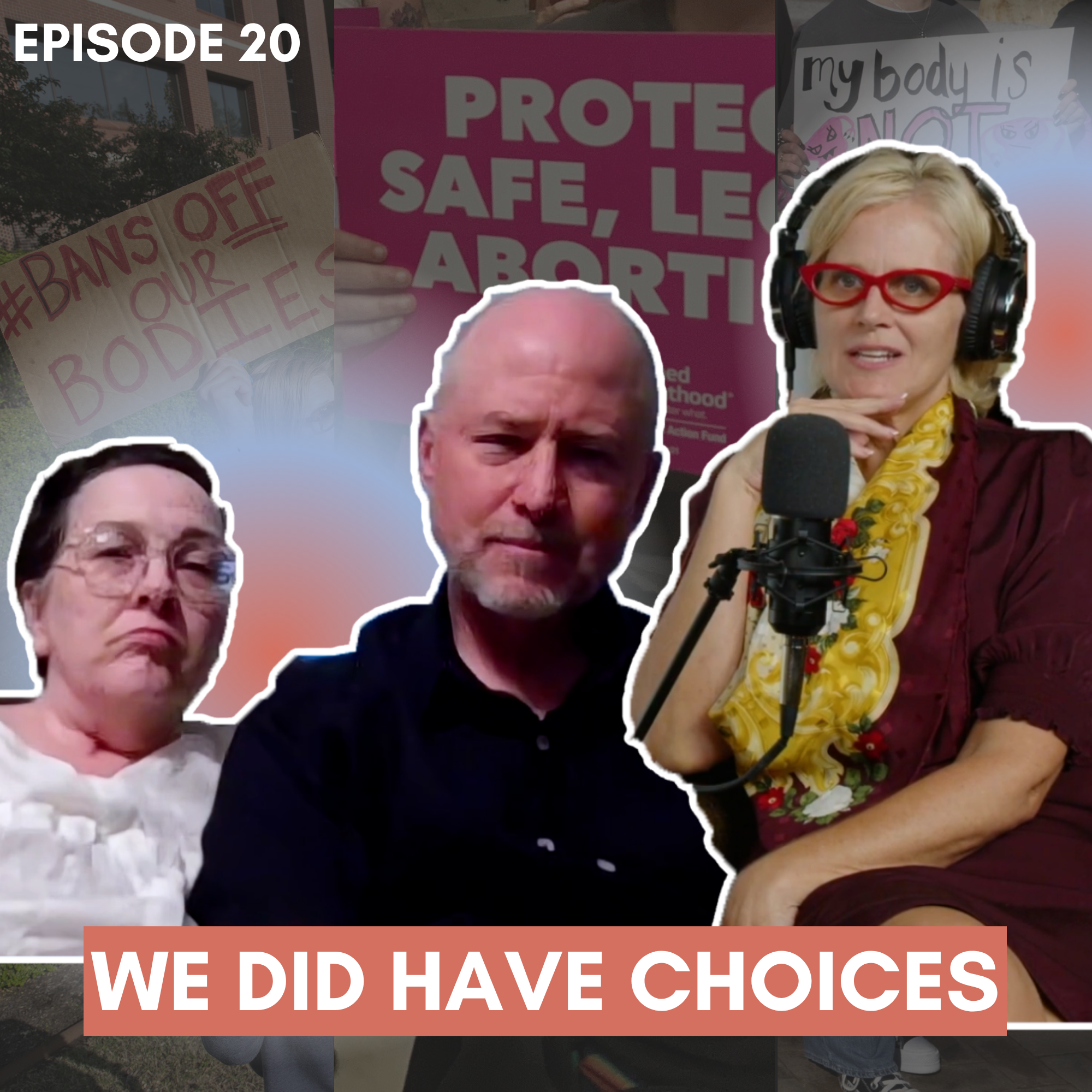
Episode Transcript
[00:00:00] Speaker A: When I consider a law is I try to think, what freedom do I want for myself if I'm in that situation? You said that over and over, Sid. You know, having that choice like that was all you could control.
You know, you were handed a devastating set of cards when your baby, you find out your baby's not developed the brain.
That's nothing you had control over. It's nothing you could change. It's nothing you could have done anything different. That's just, that's how it was. But you had the choice of what to do in that situation. I want that choice for everyone. I would want that choice for myself. If I was in that situation. I would want the choice for myself if I was raped, I would want the choice for myself if my life was endangered. So many things I would want that choice for my 14 year old daughter. And so if I would want that for me, who am I to say that it should? Not that it should be any different for any. Anyone.
Welcome to Small Town Girl.
And welcome to Greg and C. Sid Adams. I'm so thankful to have you here with me today. Very grateful for your bravery and your willingness to tell your story. I met Greg, it's been a minute now. And heard his story kind of in a roundabout way. I think it was John Brummett who first mentioned it to me.
And this was before the overturning of Roe v. Wade then triggered the, this total abortion ban in Arkansas. I read a story that you had written, Greg, or that you guys had written together about your experience with your baby, Carrie. They needed the kind of health care that is now illegal in Arkansas. I've had the privilege of interviewing a couple of women who have suffered under this, Dr. Emily Waldorf and then another woman named Danielle Williamson, who are coming forward to tell their stories. It has been so interesting to hear their sort of horrifying accounts of needing this care and not being able to get it in Arkansas and juxtaposing that in my mind with your experience of needing that care and having it and how sad the situation was, but also how beautiful your experience was getting to get the care you needed and say goodbye to your baby and recover, you know, at home.
I know that it is, it is hard to share traumatic events that happen to us.
And I think for me it can be cathartic too. And I hope that that is your experience, but I do appreciate it just up front your willingness.
So I don't know how you guys want to piggyback on each other or who wants to start, but tell us a little bit about yourselves and what brought you to the place of your pregnancy with baby Carrie. Before we get into today's episode, a word from our sponsor.
Southern Loft believes that your home should reflect your unique personality. That's why they offer a wide variety of stylish furniture pieces that are perfect for any taste.
Whether you're looking for a new sofa for your living room or a sleek dining table for your kitchen, they have just what you need.
So when looking for that piece of furniture that reflects you, visit Southern Loft at 3155 North College in Fayetteville, or call at 479-856-6100.
[00:04:08] Speaker B: Carrie was our second child and our first son.
Our daughter Laura was about three years old when we got pregnant with him. We. We planned it. We were excited about it, and Laura was excited. She named Carrie because her favorite books at the time were chapter books that. That came from the Little House in the Prairie series. And they all started the same way that Laura lived in the big woods of Wisconsin with her ma, her pa, her. Her big sister Mary, and her baby sister Carrie, and their good old bulldog Jack.
[00:04:47] Speaker A: Yes. Yes.
[00:04:48] Speaker B: And so she would, you know, that she began every story and she.
And so as soon as she understood that there was a baby, she. She gave the baby that name and Baby Carrie. The baby's name. Right?
[00:05:03] Speaker C: Baby Carrie.
[00:05:04] Speaker B: I love that. Baby Carrie.
And so that's. That's where. That's where his name came from.
I also had a cousin named Carrie. So I was.
The spelling was taken care of, and he was a man. And so we. It was just all. It's was perfect. Serendipitous. I see.
[00:05:26] Speaker C: At that time, we didn't know the gender of the baby, sex of the baby.
[00:05:30] Speaker B: We had it. What I'm saying is it was covered either.
[00:05:32] Speaker A: Either way. Right. K, A R R I, E, I think, is how Carrie Ingles. And then your baby ended up being K E, R, R. Yes.
[00:05:41] Speaker B: Correct.
[00:05:42] Speaker A: Okay.
[00:05:43] Speaker B: So. So that is where it started for her, for me, you know, and I guess for both of us, to some degree. It was. It was what we had planned and what we wanted. And we were planners. We waited to have Laura until we'd been married several years. Six years, I think.
And. And so his coming was just as planned as hers. And we were excited.
Laura was the first girl in Greg's family in many years and the first girl in our family in several years. And so we were just excited to add to that and to grow our family in that way.
And for me, Almost immediately, it was an odd pregnancy.
I felt uneasy, and I just told myself I was, you know, I. I am a worrier. Yeah, I was worrying and.
And fretting and. And we had had family experiences where we had babies with health concerns and. And I'm a special ed teacher. And so I talked myself out of it multiple times about this is, you know, it's because of what you do. It's because of, you know, all that family experience. And so. So all through it, I just kept saying, you're just a worrier.
[00:07:13] Speaker A: So what was the difference, Sid? The pregnancy was different than with Laura.
[00:07:20] Speaker B: As the pregnancy got closer to its end, I began to feel bad. But up until that point, I was just worrying.
And I wouldn't do things like I wouldn't talk about names until I felt kicking. And so I was waiting for kicking. Interesting. Kicking was my.
My thing that I was waiting for. And unfortunately, we didn't get to feel him kicking. He was quite small.
And so Even at the 21 week mark where he was born, I hadn't felt him kick.
But that was my benchmark. It's like when I feel him kick, then I'll. Then I'll be ready to talk names and plans and. Okay. And all the things. And so it just. It just. I was uneasy the whole time. And I.
My sister had had a similar experience and a baby that she lost. My mom had had a similar experience when I was born. And so it was just this sense that something was off.
[00:08:27] Speaker A: Interesting.
Okay.
[00:08:29] Speaker B: And so for me, that's kind of how it started out and how it finished.
[00:08:33] Speaker C: But so midway through the. I didn't have any of those kind of experiences that Sid was having.
[00:08:39] Speaker B: He is not the warrior. He says, I do enough of that for both.
[00:08:42] Speaker C: Oh, she carries that torch.
And for us, I try not to be oblivious, but. But try not to worry too much. And I've been fortunate that in that way in life. But I remember the day when I was at work. Now I'm a social worker in a children's hospital, and I worked in the childhood cancer world. And so Sid and I definitely both had professional experiences along with personal experiences with kids who have really serious health concerns and disabilities.
But I remember when Sid called me and said that we've gotten the results of a test back and that that were worrisome, this maternal fetal alpha protein test that they do, and it came back really high and so. So much so that they wanted to repeat the test.
[00:09:36] Speaker B: I thought something was wrong with the test because the score was like a 27 and 7 is considered astronomically high.
[00:09:44] Speaker A: Oh, gosh. Okay.
[00:09:47] Speaker B: So they thought surely something had gone wrong with the test.
[00:09:50] Speaker A: Yes.
[00:09:51] Speaker C: So she went in and had a repeated test and the score was even higher.
This was before the Google days that we have now.
And so working at a children's hospital, I went down to the medical library and asked the medical librarian to help me to search for some articles about what, you know, these situations where you have a really high, you know, test score for that test. And.
And we got those some articles and over the weekend, you know, we read them and everything was, frankly, was bad.
[00:10:31] Speaker A: Yeah.
[00:10:32] Speaker C: I mean, it was. It was all very worrisome. And.
And they scheduled Sid for level two ultrasound, you know, to.
That was going to happen on the Monday.
[00:10:48] Speaker A: That must have been a hard, hard weekend waiting, long weekend.
[00:10:52] Speaker C: Yeah. And people were. Who we knew and shared that with, you know, they were trying to be encouraging about, you know, it'll probably be fine and things like that.
[00:11:00] Speaker B: It could be this or it could be that or it could be the test.
[00:11:04] Speaker C: And I had one social work friend at the hospital who used to do genetic counseling before she came to the hospital.
And I ran into her in the hallway, and she said, I'm glad I ran into you. She said, I've heard about what you're going through. And I gave her the details of it.
And I so appreciated her because she said, I have never seen anything good with numbers like that.
And it just confirmed what we were reading and thinking. And so she didn't. So I just appreciated her frankness.
[00:11:42] Speaker A: Yes.
[00:11:43] Speaker C: Honesty about that situation.
[00:11:47] Speaker A: So you prepared yourselves a little bit for some bad news.
[00:11:51] Speaker C: I think so.
And so when we went into the level 2 ultrasound, my memory is. And still need to fill in hers, but my memory is I was watching the ultrasound technician, a young woman who was doing the ultrasound and looking at the blurry pictures on the screen that I couldn't make any sense of. That was not my expertise at all. But she had tears in her eyes.
[00:12:24] Speaker A: Oh, gosh.
[00:12:25] Speaker C: And. And she left the room and he
[00:12:29] Speaker B: grabbed paper towels right as she walked out.
And that can't be good.
[00:12:34] Speaker C: And then a doctor came in who.
Who I could not recognize today.
And.
And for me, at least, I don't remember his name. I don't remember he looked like. But I just remember.
But I just remember that he was kind and he was honest.
And then he did the ultrasound, and then he told us what the situation was, that the baby had no brain, and that was a condition called anencephaly.
And he told us that it wasn't our fault and that we did have some choices and that the choices is we could continue on with the pregnancy or we could do.
We could induce labor because this was not viable, you know, for life.
[00:13:28] Speaker B: Yes.
[00:13:29] Speaker C: And. Or we could, you know, have a DNC and stop the pregnancy that way.
So we did not make a decision at that time. We were. We went home.
So let me stop there, though, because you wouldn't want to.
Dylan, what your experience.
[00:13:46] Speaker A: Yeah. How were you feeling then, Sid, When?
[00:13:51] Speaker B: You know, a mix of confirmation, like, I'm not crazy.
[00:13:55] Speaker A: Yes.
[00:13:58] Speaker B: And sadness. I knew that that test measured for neural tube defects. I knew what neural tube defects were. I worked with children who had spina bifida.
My biggest worry at that point became if it was a neural tube defect, it was one thing to have it in one place on your spine and another to have it in another place on your spine. So it was the difference between bladder and bowel control and breathing. If it were too high, our child wouldn't be able to breathe. And if it were low, they wouldn't be able to walk, but they would. They would be able to have a meaningful life.
And so, in my mind, I didn't want to make that decision. And so my prayer became that it be clear one way or the other that we would know what to do, that it wouldn't be trying to parse out how close it was to being able to control their own breathing, or if it was close, you know, that we would have to decide to take that risk.
[00:15:12] Speaker A: Yes.
[00:15:15] Speaker B: And so my prayer was very clearly that it be. That it would be obvious what we needed to do and that we could make a decision that was appropriate for our child and our family.
I didn't really worry about as much about raising a child with a disability. I was concerned about doing my job and having a child at home with a disability, definitely. But I didn't feel like we couldn't do that. It was worrisome.
But we had seen.
We have a. We have a cousin with a disability, and we had seen my family members do that. I have two, actually. I had a cousin and a nephew with a disability. And so I felt like I knew what that meant and what the stressors were, and I felt like we would figure it out. But I was also scared that it would be exhausting in a different way because I am a special education teacher.
[00:16:24] Speaker A: Yes.
[00:16:25] Speaker B: So it was definitely a mix, but just a prayer that it be clear.
[00:16:30] Speaker A: And so when you hear that your baby, it's Not a spinal thing. Your baby has no brain.
Did that feel clear to you?
[00:16:44] Speaker B: It was clear because two things were said to us. That social worker said to us.
If that number is accurate, which it appeared to be, she said, that means that the protein is measured in the baby's urine, and so the discharge of urine is what's measured. So for it to be that high, urine had to be gushing out of his skull.
[00:17:11] Speaker C: Protein.
[00:17:13] Speaker B: Well, the protein that they measured, so it had to be coming out in massive amounts. Oh, wow.
[00:17:17] Speaker A: Okay.
[00:17:18] Speaker B: So that made me feel like it was clear.
And the fact that they said there was no brain, there was nothing to measure in that regard. And so when they tried to make measurements, the opening at the top of Carrie's skull was so large that it was difficult to find the boundaries to make that measurement.
And so those two things for me made me feel like it was clear that he was not going to survive, that he would not have, you know, meaningful interaction or ability for any length of time. And so that made it clear to me that what I wanted was a safe delivery.
I wanted him as complete as he could be.
So pretty quickly, I knew that I could only do the induction that that fit for me.
And Greg was gracious and said, that's your call.
[00:18:35] Speaker A: Yeah.
[00:18:36] Speaker B: And so it didn't seem like a difficult call at that point. In that sense, it seemed like what fit us best.
And I pretty quickly understood that the only thing we could control was his entrance into the world and his departure and what that looked like and how we handled that. And so. So that's very quickly what I grasped onto. And I held on pretty tight to that idea that that was all we had to be.
[00:19:17] Speaker A: So how soon were you able to schedule that? Then?
[00:19:22] Speaker C: That was Monday that we had that appointment, and then Tuesday when we had the discussion in.
And it really was. You know, we try in our marriage to make decisions together and the important ones, but this one, you know, it felt like that, you know, she was the mother and that this was her body and that it was most. The most important thing was for something that she felt like would.
Was acceptable for her in this terrible situation.
[00:19:57] Speaker A: Yes.
[00:19:58] Speaker C: And there was no good outcome. It was like, what's the least terrible?
[00:20:03] Speaker A: Yes.
[00:20:03] Speaker C: And to be able to have a choice about how it went was one thing that helped it to be less terrible.
So she chose when she did that. We called and this was a Tuesday, and they said we could come in to what was then Doctors Hospital on a Wednesday night.
[00:20:25] Speaker B: They couldn't deliver at St. Vincent's because it was a Catholic hospital and Baptist doctors was where our practice, the practice that we accessed, had privileges and where they felt the most comfortable doing.
[00:20:44] Speaker C: They did a lot of deliveries back then.
And so we went in that evening, on the Wednesday evening before we went in, we needed to. We felt like we needed to tell Laura something.
But we. But we. At three, we felt like that.
That it was too much to try to explain about anencephaly.
[00:21:08] Speaker A: Yes.
[00:21:09] Speaker C: And that. And so we just said that the baby was sick, very sick, and that we needed to go to the hospital.
And with the anticipation that when we came home, that we would tell her that the baby was so sick that the baby died.
And so our associate pastor, who was for pastoral care, a saint of a person, Karen Akin, she came to her house and prayed with us and put oil on our heads.
And then we went to the hospital, blessed our journey.
And it was interesting because they do so many deliveries there. We got sent to a room, and I went down to the admissions room desk to fill out the paperwork and do all the things.
And being a young man there at that hospital where they do so many deliveries, I was on the elevator and somebody said, oh, I know what you're here for.
[00:22:12] Speaker A: Oh.
[00:22:13] Speaker C: And I. And I didn't explain what we were here for. I just said. I don't remember exactly what I said, but I. In my mind, I'm thinking, you have no idea, no idea what I'm here for. And. And at that time, too, they had.
They had a tradition where they would play chimes whenever a baby was born, which is understandable in some degrees, but for situations like ours, it was like.
Yeah, it was like lemon in a paper cut, you know, every time those chimes would go off.
Because that was, you know, in celebration of an experience that we were not going to have.
[00:22:52] Speaker A: Yes.
[00:22:53] Speaker C: And so they induced SID and then. And she was then went through labor all through the night.
And it wasn't until the next morning that Carrie was born.
[00:23:05] Speaker B: I had not experienced labor because I had a C section with Laura and she was a couple weeks early.
And it ended up that I did not experience labor very much with Noah either, because he was three weeks early.
They were both big diabetic, gestational, diabetic babies. And so that was my.
That was my sole experience of any kind of. In labor. I didn't feel much of anything with either other pregnancy.
[00:23:36] Speaker A: I was just thinking how painful that must have been. And, you know, I've had birthed four babies, and the only thing that keeps you going through that pain is knowing what you're going to get to hold your baby on the other side, you know, it's that you're.
You're going to get the prize at the end.
And so I was just trying to imagine how painful that must have been and how sad that must have felt to.
[00:24:15] Speaker B: I was pretty loopy at that point, too, that just the combinations of medications and things like that. I was sort of in and out until it got kind of down to brass tacks when it was imminent. And they told us that, you know, it'll happen so fast that the doctor probably won't make it here unless he's standing here, and even the nurses might not because it will happen so quickly. And that's pretty much what. What happened. He was born very quickly, and he was so small that it wasn't. It wasn't the same kind of pain level that I think other moms experience, because there wasn't the dilation or anything like that. And. And the medication was what caused the contractions to be intense. And so I think, you know, in terms of the actual physicalness of it, it was not what I imagine a regular birth would be. It's not. Not as long or intense. It was not as long or intense.
But I was grateful that we made the choices we made because we held him.
[00:25:29] Speaker A: And how big was he?
[00:25:32] Speaker B: He was five ounces.
[00:25:35] Speaker A: Oh, my goodness.
[00:25:37] Speaker B: I think five plus a little bit, if I remember correctly. And of course, you know, just teeny, tiny hands and feet. They were perfect.
And he was. His skin was still translucent, so he was not a typical color of a baby.
[00:25:54] Speaker C: He looked about the color of your dress.
[00:25:56] Speaker A: Oh, wow.
[00:25:57] Speaker C: Kind of a burgundy maroon color.
[00:26:01] Speaker B: And as we expected, as best we knew, he had such a large defect in his skull that he didn't really have a brow ridge.
So his eyes didn't form properly, and his ears didn't form properly, and his face was kind of miss.
It just wasn't quite right because his eyes weren't quite right.
But everything about his little body was just perfect. His. Except for his head, everything about him was.
Was perfect.
[00:26:39] Speaker A: Oh, my goodness.
[00:26:40] Speaker B: He was just tiny. Tiny.
[00:26:42] Speaker A: Yeah.
[00:26:43] Speaker B: A different color, but that's what I remember.
[00:26:45] Speaker C: I. I don't. When I think about him, I don't think about his face and his head. I think about his hands and his feet.
And so Sid slept much of the time because she had labored through the night. And we did have a friend come by. We had a different pastor came to see us, but the lungs Were not developed enough to breathe. But his heart beat for about 90 minutes.
And so I.
[00:27:16] Speaker B: You could see it because his skin was so translucent. It both raised his little chest and you could see it just like a little bird tapping.
[00:27:26] Speaker C: So I. So I. Rock demons sang songs like. We sang the Laura in cried for those 90 minutes.
And I hoped that nobody would come that we didn't know.
And it was interesting because my job at the hospital was our protocol is if a patient dies, a chaplain comes and a social worker comes.
Sometimes you know, the patient and the family, and sometimes you don't, depending on the situation.
But I didn't want to deal with anybody new. I didn't want to have to explain anything or.
Or b.
You know, have to deal with somebody else's concerns. And I was glad nobody came.
Just the nurse who was very kind and.
[00:28:10] Speaker B: Was it Ken there?
[00:28:11] Speaker C: I think. I think, yeah. I think people we knew. I think Ken came and Jane came and Bill Poe came somewhere during that morning.
And so that was Wednesday.
And we went home and told Laura.
And then we had. One of the things that Karen had strongly recommended is to give the baby a name.
And we wanted to have a memorial service. So we.
He was cremated, Very few ashes because he was so tiny.
And.
And that weekend, on that Sunday afternoon, we had a memorial service at our church in the chapel.
And our family came, and it was wintry weather, and so it was in January. And so it was difficult to know if they had a little trouble if they were going to get there or not, but they did.
And we asked that there was a song that they often sang at our church at that time, a baptismal hymn.
And we asked that that song be sang.
And some of the language is.
See this wonder in the making God's own self this child is taking.
And it just felt right.
And we spread the ashes in the prayer garden. And his name and a plaque is on the. In the. In that memorial prayer garden on the wall.
Then we, you know, later in the. In the year that was January. And then later in the year, we planted a tree in the backyard for him.
And I told Laura that we were planting a tree to help us remind us of baby Carrie. And she said everything reminds us of baby Carrie,
[00:30:16] Speaker A: Precious.
[00:30:17] Speaker C: And then years later, when. When Laura was.
I have to go back at my notes now. She was around 12, I think, and Noah was born a year later, or the son we had.
And they. Four years difference. But they've always been very tight and had such a deep connection.
And she asked me.
She Said, if Carrie had not died, would we have had Noah?
And I said, well, we had always thought we would have two children, and so if he would have survived, I think we would have just had you and Carrie.
And she thought about that for a minute, and then she said something like, well, maybe it was for the best.
[00:31:09] Speaker B: And she definitely could not imagine her life without her brother.
[00:31:14] Speaker A: Yes, of course, I'm sure none of you could.
[00:31:19] Speaker C: And, you know, sometimes, and I don't know, but, you know, to circle back when one of the reasons that Sid and I feel very strongly about and being willing to tell our story, even though together, you know, we've been through the deaths of all of our parents and some expected and some not, and, you know, over 40 years, you know, we've been through, you know, some highs and lows, and this one was certainly one of the deepest lows, I think, for us. But we feel so strongly about sharing our story because we did have choices.
[00:31:58] Speaker A: Yes.
[00:32:00] Speaker C: And it made a world of difference that we could choose what fit us and that we could do it in our home and that we had the support of our family and our friends and our church and our faith community.
We didn't have to travel out of state and be around people we didn't know.
[00:32:21] Speaker B: We did have some judgment, which was interesting to say the least, but not in the. You know, we have not experienced what people are experiencing now. And if telling the story of Carrie can.
Can give people a way to think about it, that that is different than people just haphazardly choosing abortions, which I think very rarely happens. Yes.
I think we just have the narrative about why abortions happen in this country is just so out of whack and so not accurate that if telling a story of what happened to us can give people an understanding that when something like this happens at this point, point or later in a pregnancy, when you're expecting things to be okay, it is not a. A flippant decision. It is not a happy time. It is not a relief in the sense that it's, you know, I don't have to be pregnant anymore.
I think it's one thing that we. That we thought could be useful. But I also would say I don't ever want anybody to think that what the women and men and families are going through now that we experienced at all.
Just because people did make judgments over the years, it's nothing like what's happening to people now. And that. That is so incredibly wrong.
And
[00:34:15] Speaker A: it's so inhumane, isn't it?
[00:34:17] Speaker B: It is it is. And hard to imagine.
I mean, as if ours was hard to imagine. I cannot fathom people sitting in parking lots bleeding out because they can't have the services that were provided to us.
[00:34:34] Speaker C: Well, every story is complicated.
You know, every situation is different and complicated. And, you know, I didn't at the time, I didn't think of it as an abortion.
[00:34:45] Speaker A: I wouldn't have either. Yes.
[00:34:46] Speaker C: Maybe because of the stigma of that word, you know, but abort means to stop. And we were, we certainly stopped the pregnancy.
[00:34:54] Speaker B: I don't think I thought about it as an abortion until we got home that day.
And there was a phone call at our home and it happened to be the same weekend as a Right to Life march.
And people were calling in search of support for the Right to Life march that weekend. And, and so, you know, that was weird.
First of all, yes, Greg answered the phone and he asked them, well, here's what we've been through.
What would you say to that?
And I'll let you.
[00:35:29] Speaker C: I don't even quite remember. And I think that they were.
They didn't quite know what to do with that story is my memory. But, Sid, I want you to tell the story about when we were in D.C. and there's a street protester, because I think that illustrates some of the pitfalls of how we talk about this.
[00:35:47] Speaker B: Laura and Noah were grown and living in D.C. both of them with partners and have jobs and, you know, doing life.
And I don't think Noah and Hannah was it before or after Noah and Hannah. It was before. So Noah was there, I think, for.
[00:36:08] Speaker C: He might not have been there to live there. He might have just gone with us.
[00:36:10] Speaker B: I think he might have been there for college. He went there for a semester for college. But anyway, they were Both in, in D.C. at the time, and we were going to a street fair that, that D.C. has every year at Christmas.
And, and we had enjoyed walking through it another time that we had been there. And so we were walking back and there was this young guy, looked to be early 20s, early maybe mid-20s, kind of just wiry and looked super young to me. And he was holding one of those posters that shows of baby in utero and, and ranting on a corner in D.C. about abortion and, and how wrong it is and just carrying on and we're walking and, and we both all kind of recognize that he's there. And I, I looked at Greg and said, if he's there when we come back, I, I'm not, I'm not walking past when we come Back through. If he's still there, I'm gonna say my piece.
And he, you know, he nodded and we went on and probably an hour, two later we're walking back and there he is.
And I thought, well, I, I said it, I'm gonna, I'm gonna stick to it. So I left them, Greg and Noah and Laura and Luke, our son in law, and walked over to this young man and he stopped. And I said, I guess I just want to tell you a story.
And I told him Carrie's story.
And he said, you're lying to me.
And I said, no, I'm not lying.
That's my story. That's my son. And that's what happened.
I'm not lying to you. And he said, you're, you're lying. I said, no.
And we went back and forth and I said, why would you think I would lie about something like that? He said, because you don't, you don't want me to, you don't want me to do this. You don't, you don't want me to, to, to, you know, you, you're just trying to get me to stop. Yes, I said, I said I'm trying to get you to understand. Yes. That it's much bigger than what you're, than what you're communicating. And it's not a simple decision. And people don't just fall into the decisions that they make about pregnancies in the way that you're suggesting and they're not flippant decisions. And we went round and round and round and I thought, I'm done.
[00:38:55] Speaker A: Yeah, yeah.
But he could not accept it because it was not.
[00:39:00] Speaker C: I remember you called me over to say, you need to back me up because he's not believing me. And I just went over just to tell him that, that that was our situation and she was telling the truth.
[00:39:10] Speaker A: But it didn't fit the narrative. No, you know, it didn't fit the, the narrative of someone, a typical, you know, person in his position.
[00:39:21] Speaker B: He had, he had swallowed the line of people who, I think, think that it is or want people to believe that it's a flipping easy that these people are soulless people that make these decisions. Yes. You know, and it just didn't fit. And he couldn't fathom.
[00:39:41] Speaker A: Did you ever get him to, to believe you? No.
[00:39:44] Speaker B: No, he didn't. He never.
[00:39:46] Speaker A: You know, I think he believed you.
[00:39:48] Speaker B: Did he?
[00:39:49] Speaker C: No, I, you know, on a different note, you know, when, when the abortion amendment was attempted and people were gathering signatures, you know, we were, we assisted with that, and we told our story. But also we. One day we went to southwest Arkansas and went door to door.
[00:40:04] Speaker B: I didn't. I sat in the. I sat under a tent and did it.
[00:40:08] Speaker C: You were at the library. Yeah, but. But we. We were trying to. Because, again, we felt really strongly about this, that other people should have the choice and support that we had.
[00:40:19] Speaker B: We could do it safely, the same way we can tell our stories more safely than people who experience it now. So it feels like we have to tell a story because other people might not be able to.
[00:40:30] Speaker C: Yeah. Our family is not going to reject us and our friends are not going to reject us.
But it was interesting when I went.
When I was going door to door. Sometimes when people talk, we're not quite sure about it. I would very briefly share our story and say, this is why we've. This is why my wife and I feel so strongly about this. Because.
And tell, you know, one minute elevator pit, you know.
[00:40:57] Speaker A: Yes, yes.
[00:40:58] Speaker C: And. And I.
And nobody that I did that with said, you were wrong.
All of them said, well, I can see why you did that.
I just don't think I can sign that paper.
And, of course, we respected that. But it was interesting that, that the people I talked to, at least, you know, that if you give them that kind of situation, again, it didn't fit the narrative.
[00:41:26] Speaker B: And I think that's why they were so troubled. It's like. Well, I.
[00:41:32] Speaker A: Not.
[00:41:32] Speaker B: That doesn't make sense. Right.
But they couldn't bring themselves to see that as a regular occurrence. Right.
Yeah.
[00:41:43] Speaker A: Why do you think that is that people.
That there's such a stigma and that people, I think that can't believe
[00:41:53] Speaker B: that the issue has been hijacked and has been since the 70s and that.
And we're just having, you know, we're having to run to catch up and retell and experience what we're experiencing, because that narrative won the day. Yeah. You know, and. And I think it's profoundly angering and saddening to me that people are having to experience this and it will be the deaths of women that finally, you know, in the 70s, women were dying from bad procedures, and now they're dying because they can't get the procedures that they need. And, and, and it. It's just.
It's both infuriating and maddening and sad, and I just think it got hijacked early, early on, and we didn't recover as the opposition to that, you know.
[00:42:55] Speaker A: Well, I can say, you know, coming from a, you know, a conservative evangelical background, I never Ever heard a story like yours?
It was more the idea that abortion was a form of birth control for people who were reckless.
My church operated a pregnancy crisis center. The women who operated it were very kind and loving people, but they were fully convinced, you know, that abortion was murder. And they wanted to give, you know, people who were contemplating abortion a safe place to go to not be judged for being pregnant in some kind of scandalous circumstances. Teenagers pregnant, mainly. I think that was the focus in our town because Arkansas has a lot of teenage pregnancies. So that was mostly my perspective on it. But also, you know, growing up with Roe v. Wade as a standard and a. And a protection. I think one of you said, you know, you would, you wouldn't or didn't consider this an abortion. I would have never considered that an abortion either. I would have, you know, because abortion for me was associated with mostly teens who were in a bad situation and who were going to be, you know, judged and treated badly for getting pregnant. The people at my church, I feel like, wanted to show love to them, you know, and that they wouldn't be judged and didn't have to do that. This whole issue, it's fascinating to me now as an adult to think, think through that and think of how the thing that works to truly prevent that and keep teenagers out of that situation is sex education and providing contraception. That's the way I would like to see that handled now and then. The other thing, though is just. It never crossed my mind if I would have been in the situation that you guys were in.
You know, I feel like I would have chosen the same thing. And it never crossed my mind not to have that choice or like, in my mind, that would have just been like health care. You talked about the narrative getting hijacked. I think that that is a big factor here.
You know, that abortion, anti abortion people will act like, you know, that that's, that's a lie made up, you know, that, that to call it health care is really like masking, you know, murder
[00:45:55] Speaker B: or use the term late term abortion when there's no such thing.
[00:45:59] Speaker A: Yes.
[00:46:00] Speaker C: You know, well, the other thing that affected me before we had this experience is that, you know, being a social worker in the areas that I've worked in, I have seen complicated situations.
[00:46:16] Speaker B: Yes.
[00:46:17] Speaker C: And I remember a young couple that I knew over 30 years ago who were dealing with the death with their baby who had a terminal genetic condition.
[00:46:27] Speaker A: Yes.
[00:46:29] Speaker C: And while they were dealing with that, they learned that they were pregnant.
And there was a significant chance that, that the Next baby would have the same thing.
And I remember thinking to myself, I, if they asked me and they didn't what we should do, I thought, I can't tell them what the right thing to do at this point is.
[00:46:53] Speaker A: Right.
[00:46:54] Speaker C: It's what they would have, you know, they would have to live with that decision. They decided to have the baby and because that felt right to them and I think that that was what they needed to do.
But if they had said no, we don't want to do that, we don't think that's, we can. And, and in this case I would not have, I felt like it would have been inappropriate to second guess that decision. And, and there are, you know, there are women both and girls who have been raped.
[00:47:33] Speaker B: Yes.
[00:47:34] Speaker C: And we see them in, they're seen in hospitals around this state and the country.
And to think of a 25 year old woman or a 12 year old girl and to say you have no choice at this, in this matter, you know, after this horrible thing has been done to you and now, you know, you don't have any choice about what your life looks like from, from this point on.
You know, to me that's, that is really not acceptable. Not, it's not the moral thing. But I think that.
Well, two things. One is I going on what Sid said, I think that. And this happens not just for abortion, it happens with many of the other difficult issues that we face is that there's a temptation to simplify them.
[00:48:26] Speaker A: Yes, of course.
[00:48:27] Speaker C: And to say it's this or it's this.
[00:48:30] Speaker B: Yes.
[00:48:30] Speaker C: There's only two categories, only two ways to think about it. And you hear people talk about this all the time. We're going to look at both sides of the issue as if there's only two sides of any issue.
You know, but there's a lot of ways, you know, so things are complicated. And I'm not saying that there's, that there are no values that we should be guided by, but I'm saying that we can oversimplify and misconstrue and confuse situations by doing it and putting a thing that there's only two ways to think about things.
[00:49:05] Speaker A: Right.
[00:49:06] Speaker C: The other piece that I have frankly that I take issue with for the people who feel strongly against abortion is if, and this is not my view, but if you thought that stopping a pregnancy as soon as you found, you know, taking the morning after pill was the same thing as killing a live child who's been born, if that was morally the same, then the high value of keeping a child from being killed would, in my view, lead us to say, then let's try to prevent as many of those situations as possible.
[00:49:48] Speaker A: Yes.
[00:49:50] Speaker C: Which means let's help people to make good decisions, understand their bodies, and understand and help make responsible decisions and. And have birth control available so they never even get in that situation. And you might say, well, I don't want to encourage people to have, you know, sex outside of wedlock. Well, let's compare the. Let's compare the good or the evil.
Is it, would you rather have a child die or would you rather have somebody have sex out of wedlock? I mean, even if we took that argument that said it encouraged it, which I think is. I think what we know by, you know, is that if people have good information and have good choices, they actually make better choices and are less likely that that's going to happen.
And if we have people.
But even if we just took that argument to say the highest good is to save that baby's life, even if the baby is microscopic, then we should do everything possible.
But because that's not happening, because every effort we would make to help people make responsible decisions about physical intimacy is thwarted, then I think to me, that there's a real internal conflict about how seriously should I take that art, that value?
Because if it's not. Because if that the value is to protect children's lives, then that should be the highest value.
[00:51:20] Speaker A: Well, and there's so many things that applies to. Right. Like hunger, education.
[00:51:26] Speaker C: Yes.
[00:51:27] Speaker A: You know, health care, guns.
And again, you know, each one of those issues has nuances. It's not that I'm, you know, taking this black and white stance, but I agree with you. Certainly, you know, there's so many of those things, things that get thrown out there as absolutes like that. Like the idea that a, you know, a microscopic clump of cells that is going to someday result in a baby who is born and breathing outside the womb. Equating those two things and things like that, that get thrown out, that really, when you sit down and talk to a person one on one, you.
It does not make sense. You cannot make it make sense. But it's. So we do live in this world, and I think humans, you know, have this tendency anyway, we want things to be a duality. We want things to be.
[00:52:35] Speaker B: That's what I wanted. I wanted it clear, right. I wanted it obvious.
[00:52:39] Speaker A: Right.
[00:52:40] Speaker B: Or what?
[00:52:41] Speaker A: You know, but the thing for me, you know, that's why, for me, telling these stories is so important, because when, you know, telling your story, it disrupts that narrative, like that guy on the street had the choice of whether to believe you or not. You can't do anything about it if he doesn't believe you. But, you know, reasonable people who hear this story have to stop and consider it, you know, and it's the same, you know, these other two cases of these women recently in Arkansas who thankfully both of them had the means to be able to travel outside of Arkansas to get the health care they needed. Or both of them could have been in like septic, you know, situations.
But, you know, hearing their stories disrupts the idea that this abortion ban is
[00:53:48] Speaker B: just reasonable in any way, shape or form.
[00:53:51] Speaker A: Exactly.
[00:53:52] Speaker C: What I think to me, what the situation illustrates to Gwen is that so much of life is on a spectrum and as a continual. Yes, and, and human life, I think, is like that too.
So human life from conception to birth to old age, yes, there is a continuum. And although this was one of the saddest things I've ever experienced, for me, I can only speak for me, it was not as sad as if our 3 year old daughter had died. Sure, that would have been sadder.
And when people ask us how many kids we have, I generally don't go into the story and I think I tell them we have two. But in my head I think two and a half because Carrie was not fully formed.
And part of the way we think about what it means to be human is to be able to interact and think and have the potential for that. And he just never did.
And so it was extraordinarily sad.
But I know that in our policies we have to draw lines, but I think we should be very humble about where we draw the lines and we should leave space for judgment when we can. And this is a judgment between a mom in the family and the physician and all that because it's a complicated thing. And so it's not something that
[00:55:34] Speaker B: a
[00:55:34] Speaker C: politician or a governing body can think about all every possible nuance.
And so you do have to have some. I agree. You have to draw a line somewhere.
[00:55:45] Speaker A: Well, you know, Greg, there's a couple things that this, your story makes me think of.
And one is it was a turning point for me. I have some, you know, maxims I live by, I guess, and one of my, one of my sayings, and I don't remember when it came to me, but it was, it was sometime after I became a mother and I, you know, was confronted with different things that I, I saw happening with other children and I thought about what if that was happening to my child? Or, you know, I thought about the choices I wanted to be able to make for my children and the kind of world I wanted for them. And one of the things I started saying to myself is there's no such thing as other people's children.
Because I would think to myself, if I want this for my child, then I need to want it for everybody's children. If I want my children to have a good school to go to, if I want my children to have food to eat, you know, have a, you know, be able to go to doctor appointments, be able to get their teeth fixed, whatever, I need to want those things for other people's children. So I started trying to think in terms of there, there's no such thing as other people's children. And I know that that's just a way of thinking for me. And I don't always achieve it and it's not even, always possible, but I try to think it even in terms of like someone who's really hurting my kids feeling or someone who's beating them out at something they, they want, you know, to be good at or whatever and just to try to think of other people's children as if, as if they were mine. And it's kind of the, the golden rule of just treating other people the way you want to be treated.
But the other thing is for, for myself, when I consider a law, is I try to think, what freedom do I want for myself if I'm in that situation. You said that over and over, Sid. You know, having that choice like that was all you could control.
You know, you were handed a devastating set of cards when your baby, you find out your baby's not developed the brain, that that's nothing you had control over. It's nothing you could change. It's nothing you could have done anything different. That's just it. That's how it was. But you had the choice of what to do in that situation. I want that choice for everyone. I would want that choice for myself if I was in that situation. I would want the choice for myself. If I was raped, I would want the choice for myself if, if my life was endangered. So many things I would want that choice for my 14 year old daughter. And so if I would want that for me, who am I to say that it should. Not that it should be any different for any. Anyone.
[00:58:42] Speaker B: You know, I do think that that is part of the argument is there's some systemic things that we.
Situations that we're in as a country that are part of that bad narrative that These that impact poor women and black women and Hispanic women at a different level than they, than they impact white women. And so I think again, there's just imbalances all over the place that make this such a burden.
Yeah.
It's such a negative and inappropriate argument for the situation because it impacts people all along the spectrum differently.
[00:59:33] Speaker A: Well, I've thought that about these two young women I've interviewed so far.
One of them was a doctor herself, a doctor of physical therapy.
The other one, her husband was a doctor, a pediatrician. And not only did they have the access, like, to the medical world and information and knowing like what their options were and scientifically like what was happening with them, but they both had the means to leave and go get the health care they needed. And I've been thinking about it's a class situation too, because how many women do not have those options?
I mean, in my town, there's something like the school is something like 67% free and reduced lunches.
In my college where I teach, it's a high, high percentage of poverty. You know, we can tell that by government financial aid and things like that.
And so the people that my kids go to school with and a lot of, lot of the students I serve, it would just not be an option.
[01:00:53] Speaker B: It's disproportionately impacting people who don't have options. And if you know that, that's just a fact.
[01:01:01] Speaker A: Yes.
[01:01:01] Speaker B: And so if you continue to make this argument when you know factually it's an inaccurate argument and it's a, it's a. Circumstances are not.
It's just not true. Yes. It's not honest are you doing and what are you supporting in. In reality. Right.
And that is just a whole nother. It's like.
[01:01:24] Speaker A: And how many of those stories we're never going to hear, it's such a
[01:01:28] Speaker C: gross distortion because you, you look at the, all the different varieties of why people could get in these situations and need some choices and crises that they would be in.
Social crises, relationships, safety, you know, problems, you know, birth defects, and you. And for this incredibly complex set of choices. And we're going to give one answer which is never yes.
[01:01:56] Speaker B: So let's say it is a teen pregnancy, all the things that you suggested. It's a moral issue. And a teen got in a bad situation. So we really are going to make the decision for that teenager that could impact their ability to bear children at another time when it was easier and more appropriate for them to do so.
It's really, we're going to really say it's okay for us to impact, you know, possibility to impact that here and now.
[01:02:26] Speaker A: Well, that was the other.
Yeah, that was the other thing that, you know what Greg, when he was giving those, those two source those, those two like summations, that's the other thing that, that popped in my head is, you know, I, I can imagine you guys in this situation and you mentioned that you had your associate pastor, you know, anointed your heads with oil and you prayed before you went to have this procedure. And then it's the two of you. And you said, Greg, that you didn't want anyone else to come in there even to comfort you because you wanted to have the moment by yourself, you know, with Carrie singing and your wife there recovering. And I thought what we are doing with this law is we're putting the government in that room with you. And the irony of that coming from people who mostly say that they want the government to leave them alone or they want small government, but the idea, you know, when you said that about a 14 year old girl, that would be my daughter Stella. And if she got in this situation through rape or through. Not, not that. But you know, if teenagers without access to birth control get pregnant, that's why we have this high percentage of pregnancies in Arkansas. I don't know what I would do in that situation because I've not been in it. I know what I think I would do. What I know I would do is I would pray about it, you know, and I would involve the closest people to us. And then I would want to be able to make the choice with my daughter. I would not want the government telling me one way or the other. If I chose what the government thought I needed to do, or if I didn't, I don't want the government there.
To me, that's not the role of government to be in that decision because none of us know what we would do until we're in this situation.
And it's a very private, personal situation and a tragedy I have no problem seeing.
Abortion is a, It's a tragedy. That's a tragedy what happened to you. It's a tragedy that you needed that, you know, health care available and, and I think it's a tragedy even more so now. Yes, but the procedure itself, you know, needing that procedure, whatever situation you're in, there is a tragic aspect of that for me anyway. I know not all people necessarily feel that way, but, but I do feel that way about even a minuscule, you know, bit of human life.
But but we don't have to make it more of a tragedy by, you know, inserting government.
[01:05:20] Speaker B: Being in that situation is plenty.
[01:05:23] Speaker A: Yes, yes.
[01:05:24] Speaker C: You know, I think when the people, most people have a sense of this and they know I do, too, that is different. You know, miscarriages are very common.
[01:05:34] Speaker A: Yes.
[01:05:35] Speaker C: In.
And, and they are all. And they're very sad. And they hit people differently. You know, some people, they hit really intensely. Other people, it's heavy, but not as intense. Some people might decide never to have another child again. Other people say, I'll go through it again and I'll try again.
And, and those are personal decisions to make.
I think that most people intuitively think that it's not the same as a family has four living children going to elementary school, that one of them dies every year. I think most of them knows that it's sad, but it's different.
[01:06:11] Speaker A: Yes.
[01:06:12] Speaker C: And it's. And so we can. It can be a tragedy and it can be sad, but we also, I think most people just have a sense that these are different situations.
[01:06:24] Speaker A: Like. Right. The gravity of each situation is different,
[01:06:28] Speaker C: and we need to think about them for what they are in the context that they are and have the flexibility to adjust to the context that they're in.
[01:06:39] Speaker A: That is such a reasonable expression of that, Greg.
It's the way I want us to be as Americans. Reasonable. Right. I mean, that is, It's a, It's a hard situation.
And we. That's the most reasonable thing we can do with the hard situation.
[01:07:00] Speaker C: I think I see your sign that says small town girl. You know, I. The two towns I grew up in were a town of 4,500 and a town of 2,000. And we were the county seat.
[01:07:11] Speaker A: Yes.
[01:07:12] Speaker C: You know, I feel like a small town boy.
[01:07:15] Speaker A: Yes.
[01:07:16] Speaker C: And, and I know people who I grew up with who experience life differently, but we need to make space for everybody, and we need to respect how difficult some of these issues are and not fall into bumper sticker stuff.
And we have to make the hard decisions sometimes about where you make the rules, because you have to have some rule at some point.
[01:07:44] Speaker B: Right.
[01:07:44] Speaker C: And I agree with that.
You know, being a social worker, you know, I, you know, we, we deal with some child abuse and neglect things. We say, yes, you can discipline your child, but you can't hurt them in a way that is too egregious. Right. We're not saying you could never, you know, do something that caused some discomfort. But there's a line.
[01:08:05] Speaker B: Yes.
[01:08:05] Speaker C: That we draw.
[01:08:06] Speaker B: Right.
[01:08:07] Speaker C: And where you draw that line is not always clear.
[01:08:09] Speaker A: No.
[01:08:10] Speaker C: But we do the best we can.
[01:08:12] Speaker A: Right.
[01:08:12] Speaker C: Because we know that's what we have to do and we have to try to look at it as a complicated thing. But most things are complicated. So I think we need to be it helps us to be humble.
[01:08:21] Speaker B: Yes.
[01:08:22] Speaker C: About where we try to draw that line and know that we may learn things later that will cause us to need to reflect and maybe revise the lines that we draw.
[01:08:33] Speaker A: Right.
And just doing the best we can within that that space. And so I just really appreciate your your contribution to that and just you know doing more than your part really by telling this this story. So thank you so much.
[01:08:52] Speaker B: Appreciate the opportunity.
[01:08:53] Speaker C: We do.
[01:08:53] Speaker B: Thank you.
[01:08:55] Speaker A: I'm really curious about what our listeners think so if you like this conversation leave a comment below to stay involved in this small town girl community.
Thank you so much for being here for listening to Small town girl. I love you guys.